
Refacing has a reputation problem, and it earned it.
Most people have seen a refaced kitchen that looks refaced: new doors hung on frames that were wrapped in a thin veneer, with the old wood peeking out the moment a door swings open. Edges that start lifting after a few summers. Doors a shade off from the frames because they were finished somewhere else, in a different batch, by a different company. The whole thing reads as “we did something to this kitchen,” which is not what anyone was going for.
So when we say we reface kitchens, we mean something specific — and the specifics are the whole point.
What refacing actually is
Your cabinet boxes — the carcasses screwed to the wall, the shelves, the frames around each opening — are usually the sturdiest, best-built part of the kitchen. Refacing keeps them. Everything you actually see and touch gets replaced or refinished: new doors, new drawer fronts, new exposed end panels, new toe kick and crown and trim where it makes sense. The layout stays. The plumbing stays. The counters stay.
The result, done right, is a kitchen that looks new because the visible parts are new — for a fraction of what tearing it all out would cost.
The trick with the doors
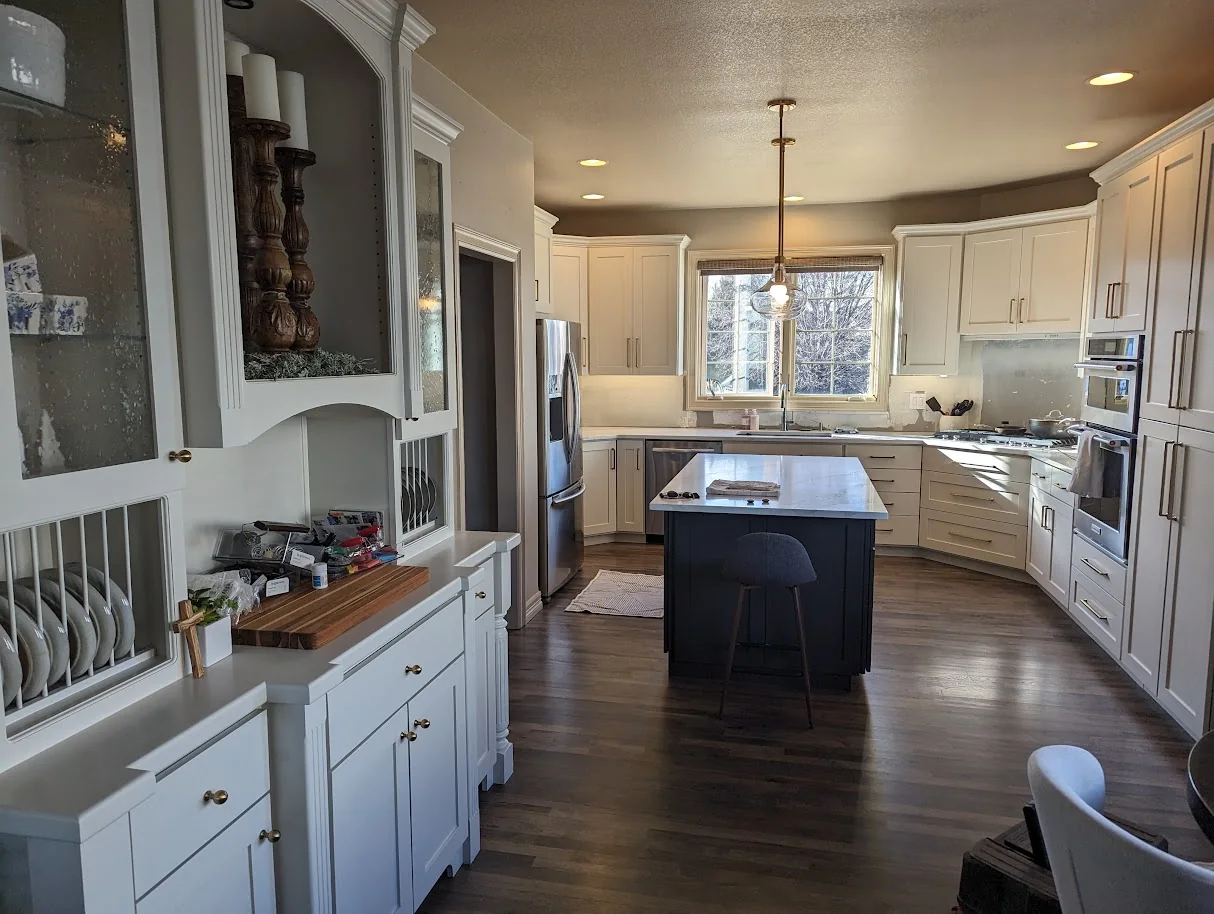
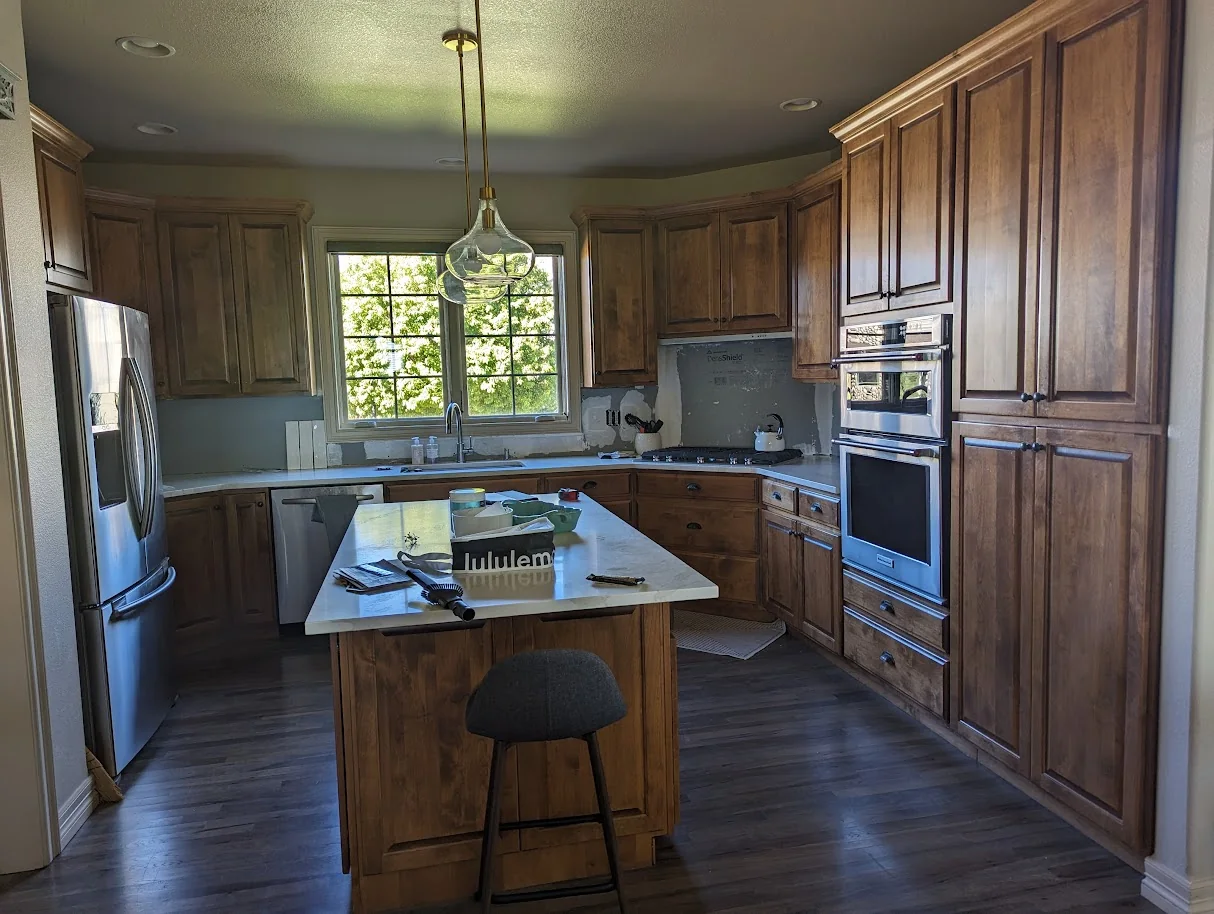
Here’s the thing that makes our refaces disappear: we upsize every door and drawer front.
Older kitchens were built with a dated “reveal” — a half-inch to three-quarters of an inch of face frame showing around every door. That gap is one of the biggest tells that a kitchen is from a certain era, and most refacers simply order new doors to the old size and hang them in the same spot, so the dated proportions stay exactly where they were.
We size the new doors to full overlay — the modern, nearly seamless look you see in new custom kitchens, where the doors cover almost the entire frame. The old reveals vanish. The kitchen’s proportions change. And because the doors now hide most of the frame, we have a lot more freedom in how the frames themselves get finished — which matters for the next part.
We don’t know of another shop around here that does this as standard. It’s a small decision that changes everything about how the finished kitchen reads.
Painted reface vs. stained reface
A painted reface is the simpler of the two. Think of it like one of our painted refinishes — frames prepped and sprayed in place behind a containment wall — except the doors and drawer fronts coming back are brand new, in whatever style you picked. If your drawer boxes are tired too, we can replace those at the same time.
A stained or clear-coated reface is the part we’re proudest of, because almost nobody else does it properly. Instead of wrapping your face frames in veneer, we strip them fully back to bare wood. New end panels, toe kick, crown, and trim go on. Then every piece — the stripped frames and the new doors — gets stained or clear-coated to match. The new doors come in the same or a closely related species (maple, alder, cherry, or oak, hickory, walnut), and because the upsized doors hide so much of the frame, the match works even across similar woods.
Veneer wraps show the moment you open a door, and they can let go over time. Stripped and finished wood is wood. As Clay puts it: literally no one can tell it happened, even if you open the doors — and it will outlast our warranty. (That warranty is ten years.)
Pick the door, pick the finish
The door styles we reface with right now: Shaker, Beveled Shaker, Micro Shaker, Modern Flat Panel, and the raised-panel profiles Telluride, Durango, and Ridgeline. Any of them can be painted any color, or stained in a species that suits your kitchen. We bring door samples, a drawer box, and hardware to the estimate visit so you can see them in your own light instead of guessing from a screen.
What it costs and how long it takes
Most full-kitchen refaces run $12,000–$20,000, depending on the size of the kitchen and the door style. That’s real money — and it’s still well under a full replacement, which typically runs three to five times the cost of refinishing and lands far above a reface, before you’ve torn out a single counter. We can also split a project by room: refinish where the doors are fine, reface where they aren’t.
On timing, plan on about two weeks start to finish once your doors are in hand. New doors add some lead time on the front of the job — we’ll give you the current number when we quote. The kitchen itself is out of commission while we’re working in it, but we’re talking days behind a dust wall, not the month or more of a remodel. No demolition, no plumbing torn out, no living out of the garage until spring.
When we’ll tell you not to reface
Honestly: sometimes a reface is the wrong answer, and we’d rather say so at the kitchen table than after.
If your boxes are failing — water-swollen bottoms, shelves pulling loose, frames out of square — new doors are hanging on a problem. If you hate your layout, a reface locks it in. In both cases we’ll point you toward a replacement conversation, even though that’s not work we do.
And if your doors are solid and you just don’t love the color anymore, you probably don’t need a reface at all. A refinish — your own doors, resprayed — gets you most of the way there for a lot less. The before/after at the top of this post is a reface; plenty of the kitchens in our gallery are refinishes. Both are good answers. The right one depends on your doors, not on what we’d like to sell you.
One we think about a lot
A homeowner painted their kitchen with a cabinet-paint kit from the hardware store. A year later it was cracking and peeling off in sheets. The boxes underneath were fine, so that’s what we saved: stripped the frames, ordered new doors and drawer fronts, finished everything together. They got the kitchen they were trying to paint their way to in the first place — and this time it’s going to stay that way.
Thinking about new doors? Request a free refacing estimate and we’ll come measure, bring door samples and hardware, and give you a written quote — for a reface, a refinish, or a bit of each. Loveland, Fort Collins, Greeley, Boulder, the Denver metro, and everywhere within about fifty miles of our shop.